

AI-Powered Finance: The CFO's Strategic Playbook
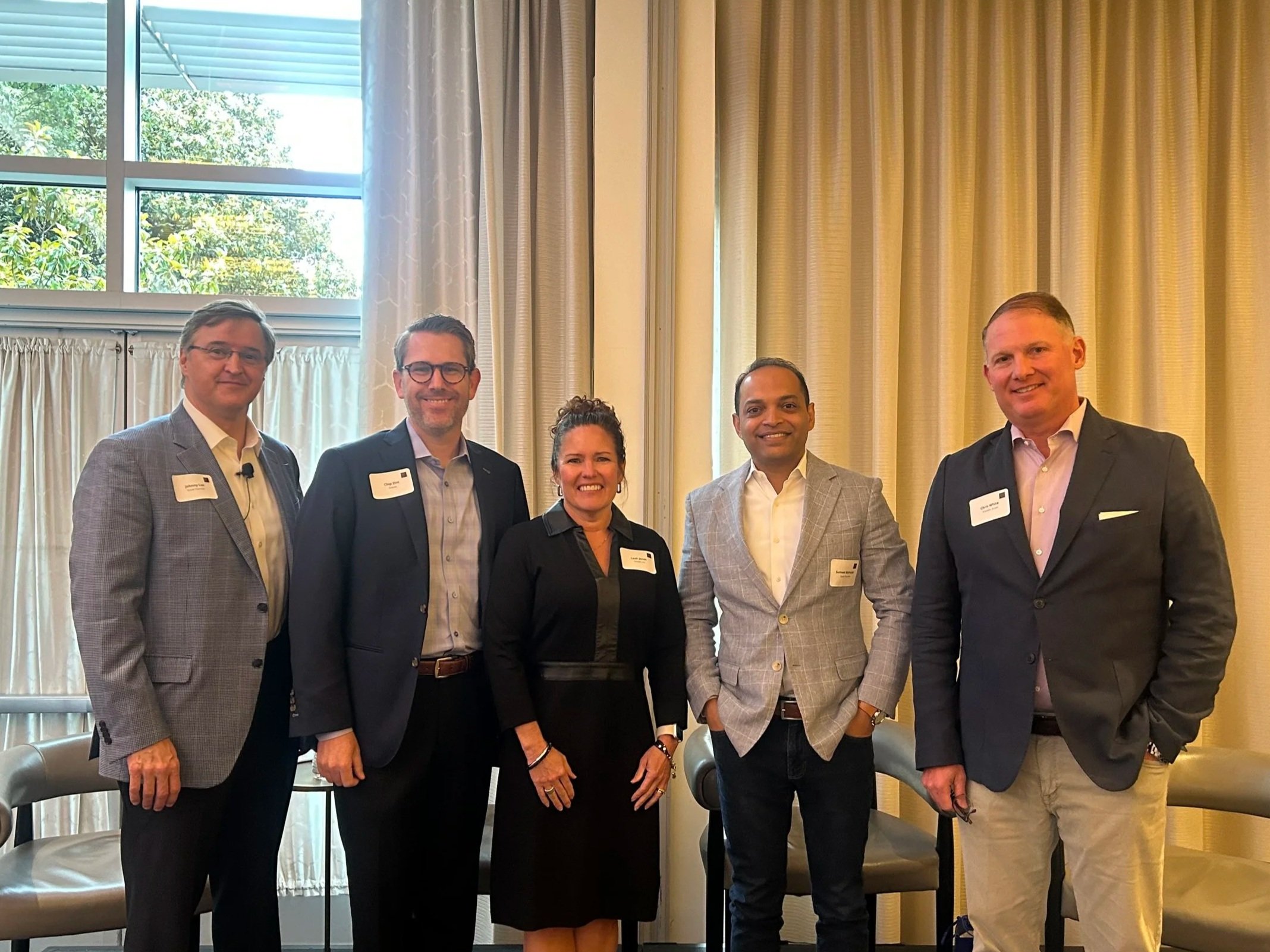
From left: Johnny Lee (Grant Thornton), Chip Zint (Deluxe), Leah Jones (Avodah), Sumeet Mahajan (Grant Thornton), Chris White (The CFO Forum)
The technology is no longer the constraint.
The Q2 2026 CFO Forum convened senior finance leaders to move beyond AI pilots toward measurable productivity and lasting advantage. Moderated by Johnny Lee of Grant Thornton, panelists shared three-plus years of hard-won lessons. The consensus was clear: governance, people, and disciplined prioritization — not the technology — now separate the leaders from the laggards.
Panelists agreed that value comes not from individual licenses but from re-engineered workflows and a handful of high-conviction, top-down use cases. Recurring themes ran throughout the morning: governance as an operating system rather than a policy document, human-in-the-loop as the default control, “thin-and-long” training that builds real capability, and a decisive shift from AI-for-efficiency to AI-for-excellence.
The companion AI Playbook distributed to every attendee frames the same path across three sections — the Landscape, the Playbook, and Governance, Risk & Readiness.
Voices on the stage


Seven themes from the conversation
Governance Is the Differentiator — Build It as a System
- Deluxe: A cross-functional governance body — technology, legal, compliance, and division presidents — controls the intake that validates, funds, and stands up each tool. The company commercialized AI in its products before rolling it into back-office finance. (Chip Zint)
- Avodah: In a regulated healthcare-IT business of ~50 people, governance starts with the customer’s regulatory environment. The core control is human-in-the-loop and “dual pathing” — every AI-assisted output gets a second human check. (Leah Jones)
- Grant Thornton: Think people, process, technology. Triage data and use cases by red/green — green (e.g., meeting transcripts) bypasses heavy review; red (PII, customer data) is gated. (Sumeet Mahajan)
- From the Playbook (p.14): The six areas the CFO must own — data quality & privacy, model transparency, human-in-the-loop, vendor due diligence, change management, and board & audit readiness. Building governance as a system makes a firm roughly 10x more likely to pass an independent audit.
“Governance — people think of it as the brakes. It’s not. Done right, it’s the accelerator.” — Sumeet Mahajan, Partner, Grant Thornton
Audit Readiness Means Reproducibility
- In financial services, a credit decision has long had to be reproducible 90 days later; AI extends that standard to every industry. Emerging tooling traces each decision back to the data, the prompt, the person, and the workflow. (Sumeet Mahajan)
- Cybersecurity is the analog — the firms that got it right stopped treating it as an IT phenomenon. Don’t hand an agent a process that isn’t documented or consistent. (Johnny Lee)
- From the Playbook (p.5, 18): 46% cite governance or compliance as the leading cause of AI underperformance, and only 8% say AI is not underperforming. Vendor agreements should require tamper-evident logging and reasoning traces usable by examiners.
“When you outsource a process you don’t know very well, it just breaks faster — in ways that are weirder than before.” — Johnny Lee, Partner, Grant Thornton
Insurance and the Emerging Risk-Transfer Market
- AI language is already appearing in insurance renewals; expect cyber-style maturation from a half-page questionnaire to a 42-page underwriting essay. (Johnny Lee)
- Last year’s renewals emphasized visibility and transparency; this year’s are expected to focus more on cost and coverage. (Chip Zint)
- A consortium — with Anthropic, Stanford, and others — formed the AI Underwriting Consortium and released AIUC-1: “trust in a box,” a framework to certify agentic deployments and re-certify on a recurring cadence. (Sumeet Mahajan)
Training That Sticks: Thin-and-Long, Not Crash Courses
- Deluxe: Moved from Copilot to enterprise ChatGPT with a 3×3 grid — three personas across three tracks. Leadership tells the org to expect the tools to change and to treat token allocation as a form of capital. (Chip Zint)
- Grant Thornton: What works is a six-to-ten-week capstone at two-to-four hours a week, where learners define their own problem, build an agent, often fail, and iterate to a real “aha.” (Sumeet Mahajan)
- Avodah: The unlock was humility — admitting to the tool that you don’t know how, and letting the model walk you through it. (Leah Jones)
- From the Playbook (p.15, 21): 73% have deployed AI but fewer than 10% of the workforce is trained; only 20% have redesigned roles. The CRIT prompting method — Context, Role, Interview, Task.
“If you’ll just admit — with a little humility — that you don’t know how to start, the AI will actually train you on what you don’t know.” — Leah Jones, CFO, Avodah
From Skeptic to Adopter: Forgive the Tool and Come Back
- A first all-AI presentation was “terrible,” but the advice stuck: if it fails this week, it will likely work next week. (Chip Zint)
- A small-company CFO used AI to ramp fast; her accountant integrated Claude with HubSpot in about a day, and the team later built a company landing page without IT. (Leah Jones)
- A year ago the advice was “treat it like a reasonably sober intern” — but interns improve; if you don’t like the output, wait six weeks for the next model. (Johnny Lee)
“If it doesn’t work this week, it’ll probably work next week. Constantly forgive it and constantly go back to it.” — Chip Zint, CFO, Deluxe
From Google-Search to Agentic Workflows
- Avodah: Agents enforce clinical context in the company’s ambient-scribe product to prevent hallucination, and keep translation faithful to context. “Femur, not female.” (Leah Jones)
- Don’t conflate automation with AI — the differentiator is context retention. AI doesn’t clean bad data, but it holds context. (Sumeet Mahajan)
- Deluxe: Wraps a personal agent in guardrails (board-appropriate, no material non-public information), and sees agents as a way to reshore work once sent offshore. (Chip Zint)
- From the Playbook (p.9, 17): 74% are granting some agentic access, but only about 1 in 5 have a tested incident playbook. Value concentrates in six finance use cases — reporting & analytics, FP&A/forecasting, controllership & the close, procure-to-pay, internal audit, and order-to-cash/treasury/tax.
ROI: Measure Excellence, Not Just Efficiency
- A heavy-equipment maker compressed 2,000-to-20,000-page RFP responses from six months to two with AI extraction plus human design. Pick four or five top-down use cases, not fifty. (Sumeet Mahajan)
- Investors asked “what’s your moat?” for two straight days. Some AI spend is table stakes; the big bets need discipline — but “you can’t be so rigid that everything needs a perfect ROI.” (Chip Zint)
- For a growth-stage company, AI is table stakes — the question is “how do we multiply capacity and get to market faster?” (Leah Jones)
- The WEF figure that 98 million jobs disappear is paired with 172 million new jobs created — so measure quality, consistency, and speed-to-market, not just cost. (Johnny Lee)
“We think about AI for efficiency. We don’t think enough about AI for excellence.” — Sumeet Mahajan, Partner, Grant Thornton
The AI proof gap
“AI-Powered Finance: The CFO’s Strategic Playbook”
Distributed to every attendee, the Playbook is a living document meant to be marked up and used. A few anchors reinforce the panel.
Anchor the program with four questions
Where does AI create the most value? How do we redesign jobs and skills? What governance must Finance own? How do we measure success?
A 90-day action plan
Days 1–30: baseline usage against the 73%-deployed / <10%-trained gap and run an audit-readiness self-assessment. Days 31–60: pilot continuous close and FP&A, and stand up the governance operating system. Days 61–90: measure against the Day-1 baseline, redesign roles, and brief the board with audit-ready evidence.
Protect your data before you prompt
Enterprise AI tools train on your inputs by default. Opt out of data sharing everywhere, reserve enterprise-grade tools for anything sensitive, and never let AI touch your live master data.

Request your copy of “AI-Powered Finance: The CFO’s Strategic Playbook.”
From the room


